
What Is Halal? A 2026 Guide to Malaysia’s Food Culture and 10 Must-Try Halal Dishes
Malaysia operates the world’s most respected halal certification regime — the JAKIM mark is recognized by 60+ countries and treated as the global gold standard by the Organisation of Islamic Cooperation (OIC). But Malaysia’s halal scene is far more than “food for Muslims.” It’s the meeting point of Malay, Indian-Muslim (Mamak), and halal-certified Chinese cuisines — making this one of the most flavor-dense countries on Earth, halal or not. This guide explains what halal really means for visitors and locals, then walks you through 10 iconic halal dishes every foreign visitor should try. We’ve added KLOOK cooking classes and street-food tours that go deeper, plus the Saily eSIM code that keeps you online while you hunt down the best Nasi Lemak in town.
Klook.comWhat “Halal” Means in Malaysia
“Halal” is Arabic for “permissible.” In food terms, it covers ingredients, slaughter methods, and food-handling environments compliant with Islamic law (Sharia). Core rules:
- No pork, no pork-derived ingredients, no alcohol
- Meat must come from animals slaughtered by Islamic method
- Cookware, utensils, and storage must be kept separate from non-halal items
Malaysia’s certifying body, JAKIM (Department of Islamic Development Malaysia), issues a green octagonal logo with “Halal Malaysia” written in English and Jawi (Arabic script). Most major chains (McDonald’s, KFC, Starbucks) carry this mark, so finding halal food is rarely difficult. You can verify any restaurant or product via JAKIM’s official Halal Status Check page or the Halal Malaysia Portal. JAKIM also endorses the “Verify Halal” smartphone app, which lets you scan a product’s QR code to confirm its certification instantly.
Three Cuisines, One Halal Plate
Malaysian halal food is really three culinary traditions woven together:
- Malay: coconut milk, sambal, lemongrass, pandan leaves — Southeast Asian foundations
- Indian-Muslim (Mamak): curries, roti, and the legendary 24-hour stalls
- Halal Chinese: pork-free noodles and dim sum at certified halal Chinese restaurants
For foreign visitors, this means three cuisines in one country — without ever leaving halal territory.
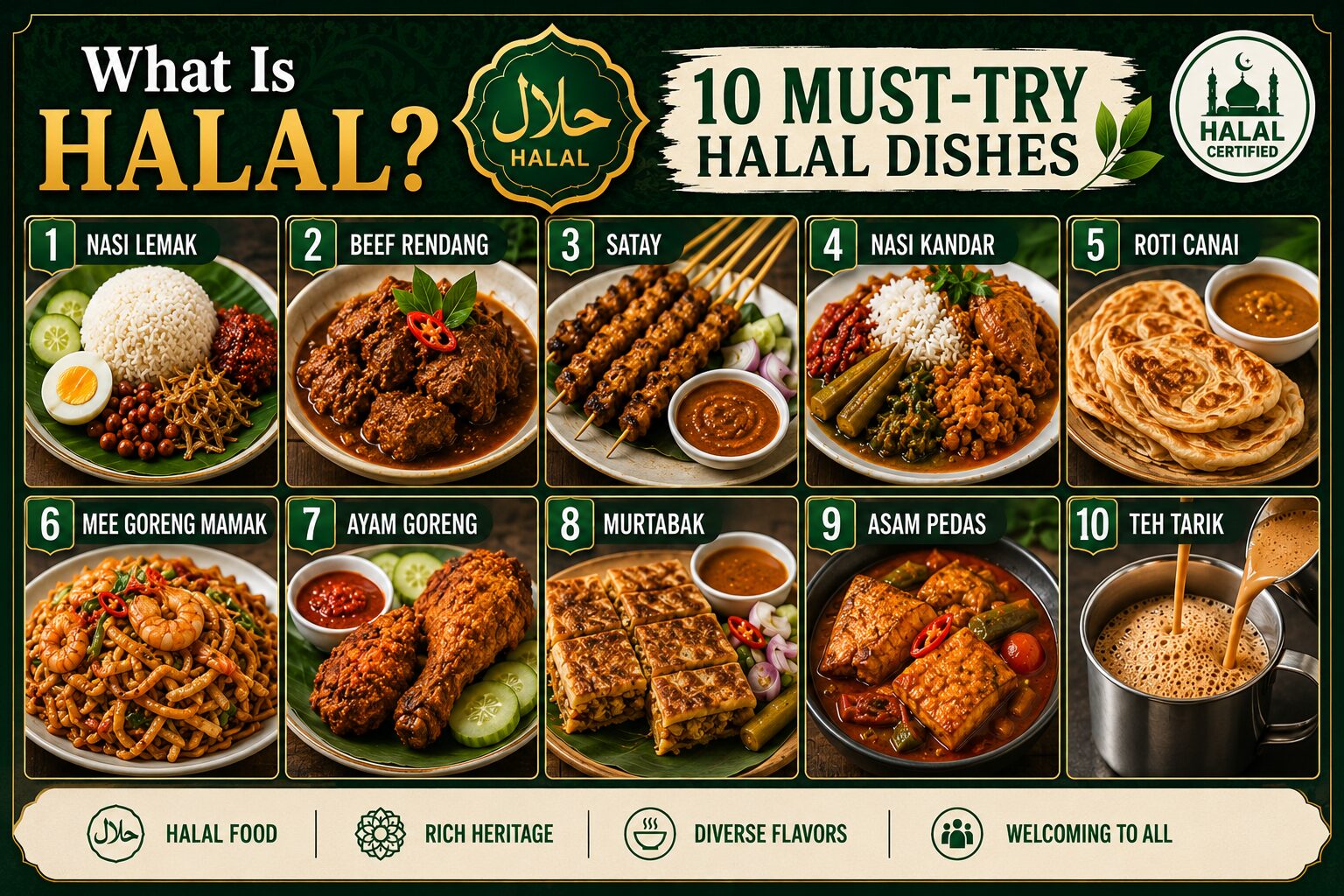
10 Must-Try Halal Dishes in Malaysia
#1 Nasi Lemak — The National Dish
Rice cooked in coconut milk served with sambal (chili paste), crispy anchovies (ikan bilis), peanuts, boiled egg, and cucumber. Eaten any time of day, anywhere. Add chicken rendang or sambal prawns for the full experience.
#2 Beef Rendang — The Slow-Cooked Masterpiece
Originally from Sumatra, beef rendang has been adopted as a Malaysian national dish. Beef simmered in coconut milk and spices for 6–8 hours until the sauce thickens into a dry, caramelized coating. CNN once ranked it #1 on its “World’s Best Foods” list.
#3 Satay — Charcoal-Grilled Skewers
Meat (chicken, beef, or lamb) marinated in turmeric, cumin, and lemongrass, then grilled over charcoal. The peanut sauce is the star — tangy with tamarind, fragrant with ginger. Always ordered by the bundle of 10+.
#4 Nasi Kandar — Penang’s Mamak Classic
Pioneered by Indian-Muslim immigrants in Penang: white rice with multiple curries poured on top. Fish-head curry, mutton curry, and fried chicken are common combinations. Try Hameediyah (1907) or Line Clear for the heritage versions.
#5 Roti Canai — Breakfast King
An Indian-Muslim flatbread, hand-stretched in mid-air and pan-fried. Dipped into dhal (lentil curry) or chicken curry. At RM 2–3 per piece (~USD 0.50), it’s one of the cheapest gourmet experiences on the planet.
#6 Mee Goreng Mamak — The Stall Stir-Fry
A signature Mamak street dish. Yellow noodles wok-fried with tomato sauce and curry powder, plus egg, beansprouts, fried tofu, and prawns. The default 1 AM snack across the country.
#7 Ayam Goreng — Spiced Malaysian Fried Chicken
Chicken marinated in turmeric and spices, then deep-fried. Served with sambal and white rice. Even KFC Malaysia has its own halal-certified spice-coated version (“Ayam Goreng”).
#8 Murtabak — The Stuffed Roti
Roti dough filled with minced meat, onion, and egg, then pan-fried. A meal in itself — one Murtabak feeds two people. Found at most Mamak stalls.
#9 Asam Pedas — Sour & Spicy Fish Stew
A fish curry built on tamarind sourness and chili heat. Close to Nyonya cuisine in profile, but a staple in Muslim Malay homes. Paired with steamed rice, it’s deeply satisfying.
#10 Teh Tarik — The Pulled Milk Tea
The national drink. Sweet condensed-milk tea is “pulled” repeatedly between two containers to froth and aerate it. Watching the barista pour it from a meter overhead is half the show.
Regional Variations: Each State Has Its Own Halal Specialty
“Malaysian halal food” is really thirteen state-level cuisines stitched together. Plan your trip around the dishes you can only taste in their home region.
Kelantan — Bold Flavors from a Deeply Muslim State
The northeastern state where traditional Malay culture is most concentrated. Nasi Dagang (sticky rice with tuna spice curry), Ayam Percik (turmeric-marinated grilled chicken), and Roti Jala (lacy crepe-like flatbread) are the locals’ must-orders. Sweeter and richer than peninsular average.
Penang — The Birthplace of Indian-Muslim Cuisine
Beyond Nasi Kandar, look for Nasi Tomato (saffron-tinted tomato-rice with fried chicken) and Mee Jawa (Javanese-style spicy noodles). Penang’s port history made it the cradle of Mamak food.
Malacca — Where Peranakan Meets Portuguese
Chicken Rice Balls — Hainanese chicken rice molded into bite-sized spheres — is the city’s signature, with multiple halal-certified restaurants serving it. Malacca-style Asam Pedas runs a touch sweeter than versions further north.
Sabah (Borneo) — Coastal & Highland Fusion
Tuaran Mee (wok-fried egg noodles from Kota Kinabalu), Hinava (a halal-friendly indigenous citrus-cured fish dish), and Nasi Kambang (mixed-plate rice with spiced chicken) introduce flavors unfamiliar to peninsula visitors.
Sarawak — Indigenous Meets East Malaysian
Sarawak Laksa — a creamy prawn-base noodle soup (no belacan or sambal) — was famously called “the best breakfast in the world” by Anthony Bourdain. Kolo Mee, a light soy-tossed noodle, is the everyday Kuching staple.
Mealtime Etiquette: Habits That Open Doors
A few customs to know — they’re not strict rules for outsiders, but observing them earns warm reception from local hosts.
- Eat with your right hand: When eating Roti Canai or Nasi Lemak by hand, locals use the right hand only — the left is traditionally considered unclean. With a spoon and fork, this doesn’t apply.
- “Bismillah” before eating: An Arabic phrase meaning “in the name of God,” often murmured before the first bite at Muslim tables.
- “Alhamdulillah” after eating: “Praise be to God.” You’ll hear it from Malay hosts at the end of every meal.
- “Tak ada babi?” (“No pork?”): A useful phrase at non-certified stalls. The reply is usually “Tak ada” (none) or “Halal lah” (it’s halal).
Ramadan Bazaars: Halal Street Food Hits Peak
During the Islamic month of Ramadan, mosques and public squares across Malaysia host Ramadan Bazaars — afternoon-to-sunset food markets where stalls sell rare regional dishes and homemade sweets aimed at the breaking-of-fast meal (iftar).
- When: Dates shift annually with the Islamic calendar (2027 is expected mid-February to mid-March)
- How to visit: Arrive 30 minutes before sunset. RM 30–50 (USD 7–12) buys 4–5 dishes
- Top spots: KL’s Masjid Jamek vicinity, Shah Alam, Penang’s George Town
Non-Muslim visitors are welcome to browse and buy — no fasting required. The bazaars surface dishes you’d never see outside Ramadan.
A Mini Glossary for the Halal-Curious Traveler
| Malay Term | Meaning | When You’ll Use It |
|---|---|---|
| Halal | Permitted under Islamic law | Verifying a restaurant’s status |
| Haram | Forbidden (pork, alcohol, etc.) | Asking about ingredients |
| Mamak | Indian-Muslim stall | “Mamak ada dekat sini?” (Any nearby?) |
| Tak ada babi | No pork | Confirming at non-certified stalls |
| Bismillah | Pre-meal blessing | Said before eating |
| Sedap | Delicious | Complimenting the stall owner |
Final Take: Halal in Malaysia Is the Opposite of Limiting
The cliché that halal food is restrictive falls apart the moment you sit at a Malaysian Mamak stall at 11 PM. What you find instead is JAKIM-level rigor paired with multicultural depth — and for foreign visitors, the practical upshot is that almost anything you eat in Malaysia is delicious. Work your way through the 10 dishes above and you’ll have touched the heart of Malaysian food culture.
MALAYGOHAN keeps publishing region-by-region restaurant guides — bookmark us as your Malaysia gourmet companion.